

Introduction
If you have ever entered the same birth details on two astrology websites and received different birth chart readings, the confusion is understandable. Your Rising sign may change, planets may appear in different houses, or the interpretations may seem to describe two different people. The reason is not always that one website is wrong. Differences can come from the zodiac system, house system, Ayanamsha, timezone handling, birth-time accuracy, software settings, or the way an astrologer interprets the chart. Understanding these differences makes it much easier to judge what you are actually looking at and which reading deserves your trust.
Editor’s Note: This Q&A is adapted from a longer expert interview and has been edited and expanded for clarity.
Q1. Why is my Rising sign different on different astrology websites?
Your Rising sign can change between websites because of differences in birth-time entry, timezone or DST settings, location data, or the zodiac system being used.
The Ascendant is highly time-sensitive, so even a small input difference can matter when it is close to a sign boundary. One site may also calculate the chart in the Tropical zodiac while another uses the Sidereal zodiac, which can shift the Ascendant and several planetary positions. Before deciding that one website is wrong, check that the birth date, exact time, AM/PM setting, birthplace, timezone, and chart system are identical on both sites.
Q2. Why is my Vedic birth chart different from my Western birth chart?
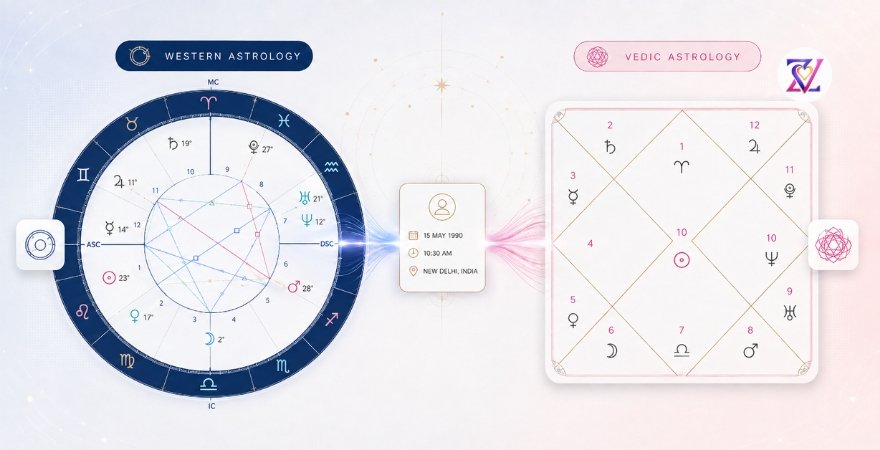
Vedic and Western charts often look different because they usually use different zodiac reference systems. Western astrology commonly uses the Tropical zodiac, while Vedic astrology generally uses the Sidereal zodiac.
The Tropical zodiac is tied to the seasonal cycle, while the Sidereal zodiac adjusts for the gradual shift between the zodiac and the visible star background. This adjustment is called ‘Ayanamsha’, also called ‘precession of the equinoxes’. Because of it, a planet shown in one sign in a Western chart may appear in the previous sign in a Vedic chart. Neither system is simply a corrected version of the other; they follow different astrological frameworks and interpretive traditions.
Q3. Why does my birth chart look like a circle on one website and boxes or diamonds on another?
The shape of the chart is mainly a matter of astrological tradition and visual presentation. A different chart design does not automatically mean the planetary calculations are different.
Western astrology commonly displays the horoscope as a circular wheel divided into twelve houses. North Indian Vedic charts are often shown as a diamond-shaped diagram, while South Indian charts usually appear as a rectangular grid. Each format organizes signs, houses, and planets differently on the page, so the same birth data can look unfamiliar when presented in another style. What matters is not the shape itself, but the planetary positions, houses, signs, and calculation settings behind it.
Q4. Why can two Western astrology websites put the same planet in different houses?
Two Western websites can show the same planet in different houses because they may be using different house systems, even when both are using the same birth data and Tropical zodiac.
Placidus, Whole Sign, Equal House, and other systems divide the twelve houses in different ways. The planet itself has not necessarily moved; what has changed is the method used to define the house boundaries. This is especially noticeable when a planet sits close to a house cusp. Before comparing two Western charts, check the house-system setting first. A chart calculated in Placidus should not be expected to match a Whole Sign chart house-for-house.
Q5. Why can two Vedic astrology websites give me slightly different charts?
Two Vedic websites can produce slightly different charts because they may use different Ayanamsha settings, calculation conventions, or software defaults.
Lahiri or Chitrapaksha Ayanamsha is widely used, but it is not the only option. Raman, Krishnamurti, and other Ayanamshas apply slightly different reference points, which can affect planetary degrees and, in borderline cases, even sign or divisional-chart placements. Differences may also come from house settings, true versus mean nodes, or how the software handles coordinates and time conversion. When comparing Vedic charts, first make sure both websites are using the same calculation settings.
Q6. Can a few minutes’ difference in birth time really change my birth chart?
Yes, a few minutes can matter, but they do not automatically change the entire chart. The impact depends on what was close to changing at the moment of birth.
The Ascendant moves continuously and can change signs when the birth time falls near a boundary. House cusps also shift with time. In Vedic astrology, some divisional charts are even more time-sensitive, so a small correction may alter important placements there. However, most planetary sign positions will remain unchanged within a few minutes. This is why an approximate birth time may be sufficient for some observations but unreliable for precise Ascendant, house, divisional-chart, or timing analysis.
Q7. Why do automated astrology websites give me contradictory personality descriptions?
Automated websites often contradict each other because they interpret chart factors separately and use different rules for deciding which placements deserve more weight.
One program may emphasize your Sun sign, while another gives more importance to the Moon, Ascendant, Venus, Saturn, or a particular aspect. Many automated reports also work like a library of prewritten interpretations: one paragraph for each placement, with limited ability to resolve contradictions between them. A human astrologer can weigh several factors together and decide which themes are dominant, conditional, or secondary. The calculation may be accurate, while the final personality description still feels fragmented or inconsistent.
Q8. Which should I trust more: an online birth chart calculator or a chart prepared by an astrologer?
A good calculator can be highly reliable for chart calculation, while a skilled astrologer is usually more valuable for interpretation. The two serve different purposes.
Software is excellent at handling planetary positions, house cusps, aspects, and timing calculations when the birth data and settings are correct. Problems arise when the wrong timezone, house system, Ayanamsha, or birth time is entered. An astrologer adds judgment: which factors matter most, how apparently conflicting indications fit together, and what is relevant to your actual question. So the real issue is not human versus software. It is accurate calculation plus competent interpretation.
Q9. If two astrologers read the same birth chart, why can they give different interpretations?
Two competent astrologers can read the same chart differently because they may use different techniques, give different factors more weight, or specialize in different kinds of questions.
One astrologer may focus heavily on planetary strength and timing, while another may emphasize relationships, psychological patterns, transits, divisional charts, or predictive techniques. Training, Certification, Experience & Mentoring also affect what an astrologer notices first. This does not mean every interpretation is equally valid, but some variation is normal. A useful reading should still be internally consistent, explain its reasoning clearly, and remain relevant to the question you actually asked.
Q10. Why does specialization matter in astrology? Shouldn’t a senior astrologer know everything?
A senior astrologer can understand astrology broadly, but that does not make every astrologer equally strong in every branch. Specialization usually leads to deeper judgment in a particular area.
Astrology is like an ocean, it includes relationship work, mundane astrology, financial astrology, horary-electional timing, remedial practice, research, and several other specialized approaches. The same way one doctor does not handle every medical specialty, one astrologer may be much stronger with relationship patterns than political forecasting or business timing.
At Zodiac Villa, we have a specialized team across dedicated branches of practice, so relationship, financial, mundane, horary, electional, remedial, and research-based questions are handled with the relevant area of expertise.
Q11. Why do some astrologers recommend remedies for almost every problem while others rarely do?
Because astrologers differ in philosophy, training, and practice style. Some consider remedies central to their work, while others use them selectively or not at all.
Remedial astrology itself is not the problem. The concern begins when remedies are sold through fear, urgency, guaranteed outcomes, or repeated claims that another paid ritual is required. A responsible remedy should have a clear purpose, reasonable scope, and no pressure attached to it. It should support the reading rather than replace sound interpretation. When every problem suddenly requires an expensive solution, the client should ask whether the advice is genuinely astrological or commercially motivated.
Q12. How do I know which astrology system or specialist is right for my problem?
Start with the problem you want to be solved, not with the astrologer’s title. The right method depends on whether you are asking about relationships, timing, business, a specific question, or a broader life pattern.
Relationship concerns are better suited to a relationship specialist. Business or investment timing may require financial astrology. A precise yes-or-no situation may be better handled through horary, while choosing a date belongs to electional astrology. Mundane astrology is used for political and collective trends.
At Zodiac Villa, we have a specialized team across dedicated branches of practice, so each type of question can be handled with the most relevant expertise.
Q13. What if I don’t know my exact birth time? Can I still trust my chart?
Yes, some parts of your chart may still be useful, but time-sensitive factors become less reliable when the exact birth time is unknown.
The Sun, Moon, and most planetary sign placements may remain usable depending on the date and time range, but the Ascendant, houses, and certain divisional charts can change significantly. This is where birth-time rectification may help. An astrologer can compare major life events with possible chart times to narrow the range, but rectification should not be treated as guesswork or certainty. If your birth time is approximate, the reading should clearly state which conclusions are dependable and which are tentative.
Q14. How can I tell whether an astrology website or reading is trustworthy?
A trustworthy astrology service should be clear about its method, its limits, and the kind of expertise behind the interpretation. It should not rely on fear, guarantees, or vague authority claims.
Look for transparency about the astrology system being used, accurate birth-data handling, clear specialization, realistic language, and explanations that connect the interpretation to your actual question. Be cautious when every issue leads to an urgent paid remedy or a guaranteed outcome. A credible reading should help you understand the chart more clearly, not make you dependent on repeated consultations. Trust is built through consistency, clarity, and responsible interpretation.
Astrologer’s Insight
At Zodiac Villa, we do not believe one astrologer should pretend to be everything for everyone. A relationship crisis, a business decision, a political cycle, a remedial question, and a precise timing issue demand different kinds of astrological judgment. That is why our work is divided across dedicated branches of practice, with specialists who stay close to their field. For us, astrology becomes more meaningful when the reader is not forced into a generic interpretation, but is guided by someone who understands the exact nature of the question.
May the planets favor your path and grace your journey with love, peace, and prosperity.
— Zodiac Villa